



Control system: the heart of the AV project
)
Imagine walking into a spectacular boardroom or a super-luxury residence. The architectural design is impeccable, but to turn on a single screen, you have to figure out how to use three different remote controls and practically read an instruction manual.
It’s a frustrating experience that completely ruins the magic of the place. This is where an unsung hero comes in—one that no one suspects: the control system, the true nervous system of any cutting-edge technological project.
When designing high-end spaces, it’s very easy to be dazzled by what’s immediately visible: a giant screen, imposing speakers, or designer lighting. But choosing the platform that will manage all of this isn’t just a technical detail—it’s a key element that defines how you’ll experience that space.
A poorly designed system turns a smart home into a constant source of frustration. In contrast, a well-integrated solution makes all the technical complexity simply disappear.
“True sophistication in modern automation lies not in how expensive an individual device is, but in its interoperability. A robust control system functions like a universal translator: it enables lighting, climate, audio, video, and security to communicate seamlessly. This is achieved through open APIs and standardized automation protocols—such as KNX for control, BACnet for HVAC, or DALI for lighting—running over Gigabit LAN networks with near-zero latency,” says Ariel Enrique Gutiérrez, president of Polaris Controls.
AI is here to change the game
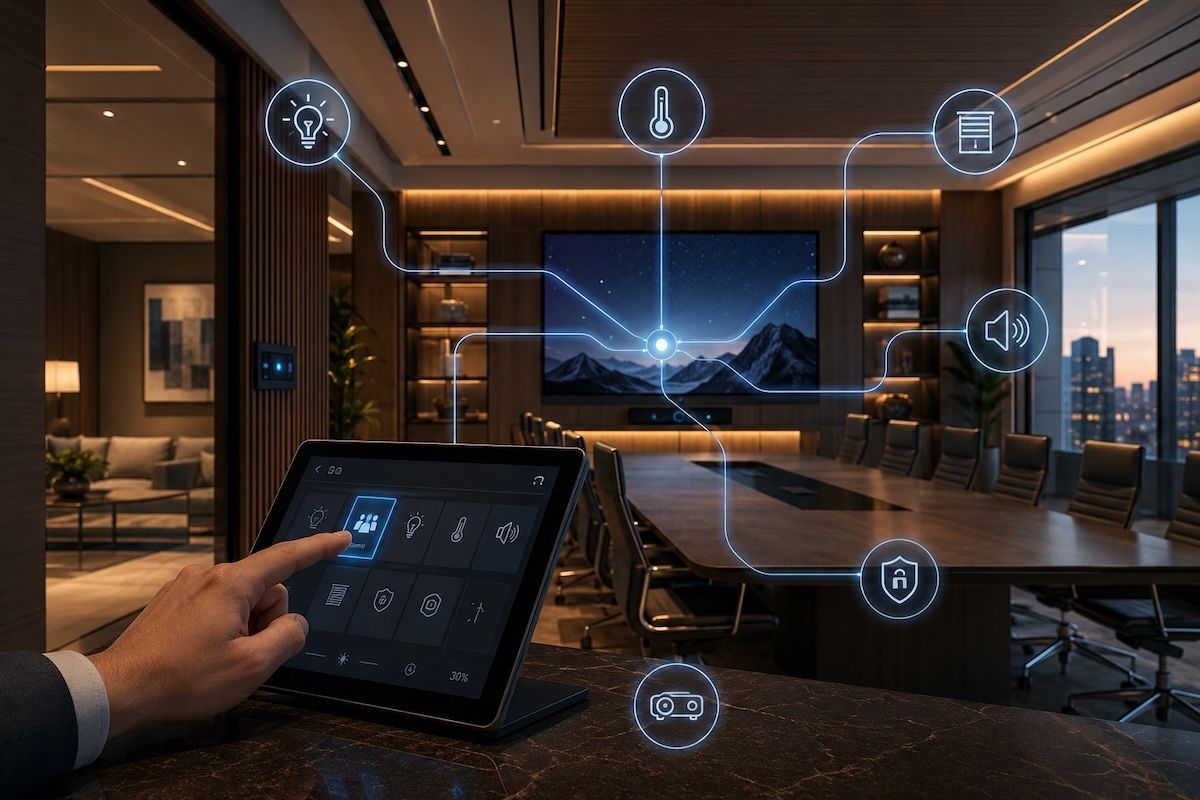
Imagine walking into a room and pressing a single button labeled "Presentation" on a sleek touchscreen. In a fraction of a second, the central processor executes a series of complex macros: the lights dim to 30%, the blinds block out the sun’s glare, the projector turns on, and the audio system is automatically routed. You don’t have to deal with fragmented interfaces; the system does the heavy lifting for you.
However, the major breakthrough today is the integration of Artificial Intelligence into the design and implementation of these systems. AI is currently used to optimize the configuration of complex Audio over IP (AVoIP) networks and to create predictive schedules.
Instead of rigid systems that merely respond to button inputs, AI allows the system to "learn" from user routines and the environment, automatically adjusting a room's acoustics or lighting levels based on the time of day and occupancy, ensuring that the project is not only smart but also intuitive.
Management and control
In the realm of entertainment and productivity, control plays a critical role in maintaining fidelity. Managing the distribution of 4K HDR video or high-resolution audio across multiple zones requires an infrastructure that intelligently manages bandwidth.
In addition, it must resolve EDID (display identification data) conflicts and the HDCP 2.3 security handshake in microseconds so that the image never flickers or fails.
With the rise of AVoIP (Audio and Video over IP) architectures and standards like Dante, high-fidelity control instructs the amplifier stage to wake up with the exact gain needed, whether for subtle ambient music or to unleash its full power in a home theater. When control is seamless, the technology becomes an atmosphere that envelops the user.
Ariel explains: “One of the greatest benefits of a centralized control system, highly valued by architects, is the drastic reduction of ‘visual noise.’ Instead of walls cluttered with switches and thermostats, smart integration consolidates these functions into minimalist interfaces that, in many cases, are powered by a single cable thanks to PoE (Power over Ethernet) technology.”
The use of elegant, laser-engraved keypads with clear functions allows the architecture to take center stage. These interfaces blend seamlessly with luxury finishes—such as marble, fine wood, or metal—making the technology omnipresent yet completely discreet.
At the end of the day, the factor that separates a home “gadget” from an industrial-grade solution is operational stability. In high-profile projects, system failure is simply not an option. For this reason, these implementations rely on enterprise-grade network topologies and remote monitoring and management (RMM) platforms. This allows integrators to proactively diagnose and resolve network anomalies, often before the end user even notices.
“At Polaris Controls, we understand that our mission is precisely to design that invisible harmony. We firmly believe that the best control system—backed by the most robust engineering and the most advanced energy management and AI technologies—is one that you don’t even notice, yet it transforms everything,” concludes the company’s president.
But that’s not all. Polaris Controls and its entire team will be at InfoComm América Latina more about these technologies and the solutions available from the brands they work with to help you enhance your upcoming projects. We look forward to seeing you in Mexico!