

Hybrid Classrooms in Latin America: Key Trends
)
Workplaces in Latin America are entering a new phase. After several years of adapting to hybrid work, many organizations are no longer asking whether they need technology to collaborate remotely, but rather how to improve the experience, standardize their workspaces, and ensure that their investment truly pays off in day-to-day operations.
The conversation is beginning to go beyond isolated cameras, screens, or microphones. The challenge lies in designing spaces where technology is easy to use, compatible with different platforms, secure for the corporate environment, and capable of providing a similar experience for those both inside and outside the room.
For the MAXHUB team, one of the most pressing needs in the region is interoperability. “In Latin America, we see a very strong need for interoperability and return on investment. Unlike other regions where a company commits to a single platform, here the environment is ‘Bring Your Own Meeting’; companies need the technology to work flawlessly whether they’re using Teams, Zoom, Webex, or Google Meet,” they explained.
This reality raises a key point for system integrators and technology leaders: solutions must adapt to diverse environments, rather than forcing companies to operate on a single platform. In many cases, a single organization uses different videoconferencing tools depending on the department, the client, or the type of meeting. For this reason, flexibility becomes a central design criterion.
User experience determines adoption
One of the major challenges of hybrid meeting rooms lies not only in the technical quality of the equipment, but also in its adoption. If a meeting room requires too many steps to start a meeting, connect a laptop, or share content, users are likely to end up avoiding the technology or resorting to makeshift solutions.
Here we see an increasingly important trend: the pursuit of consistent experiences across small, medium, and executive meeting rooms. For a company, it’s not enough to have a well-equipped main meeting room if the other spaces function differently or cause confusion.
The MAXHUB team sums up this priority in one of its recommendations for organizations looking to upgrade their spaces: “Standardize the experience: make sure that using the small meeting room is just as intuitive as using the boardroom.”
For the integration market, this presents a significant opportunity. Standardization does not mean installing exactly the same equipment in every space, but rather designing a common user experience: similar interfaces, simple processes, clear connectivity, and a predictable experience for any user.
Audio: The One Thing You Can't Overlook
Although screens and cameras tend to get most of the attention in collaborative projects, audio remains one of the most critical factors. In hybrid meetings, poor voice pickup, echo, or background noise can directly affect productivity and participation.
The company's team puts it bluntly: “In a video conference, poor video quality can be overlooked, but poor audio ruins communication. Invest in good voice capture and processing.”
For integrators, this means considering factors such as acoustics, microphone placement, signal processing, room size, reflective materials, and ambient noise levels from the very beginning. Audio quality depends not only on the device chosen, but also on how it is integrated into the space.
Physical design cannot be separated from technology
Another important change is the relationship between architecture, interior design, and AV technology. For years, many rooms were designed primarily with aesthetics or furniture in mind, leaving the technology for last. That approach often leads to wiring problems, poor acoustics, unsuitable viewing angles, or equipment that doesn’t integrate well with the space.
According to MAXHUB, this remains one of the most common mistakes: “The most common mistake is designing the room, buying the furniture, painting it, and then trying to ‘fit’ the technology in at the end.”
When the audiovisual component is introduced late in the project, the chances of achieving a seamless experience are reduced. That is why early collaboration among integrators, architects, designers, and IT teams is becoming increasingly necessary.
“Poor acoustics, highly reflective surfaces, or poor lighting can ruin the performance of even the best camera or microphone on the market.”
This point ties directly into one of the most important discussions in the industry: AV should not be viewed as a final layer of the project, but rather as a structural part of the spatial experience.
AI, Open Platforms, and Security
Artificial intelligence is also having an impact on hybrid collaboration, particularly in areas such as automatic framing, voice tracking, noise reduction, and enhancing the remote experience. However, its value lies not only in the novelty of the technology, but in how it helps reduce friction and improve equity among participants.
According to MAXHUB, the trend is toward open ecosystems, with solutions capable of integrating with the platforms most commonly used by companies.
“Our philosophy is based on an open ecosystem powered by artificial intelligence. Our cameras and soundbars use AI for automatic framing and voice tracking, ensuring equitable remote collaboration.”
Added to this is a growing concern: security. In corporate, educational, and government settings, devices must comply with network policies, user management, and internal data protection standards. For many organizations, this factor is already just as important as audio or video quality.
Interactive Displays and Corporate LED Screens Are Gaining Ground
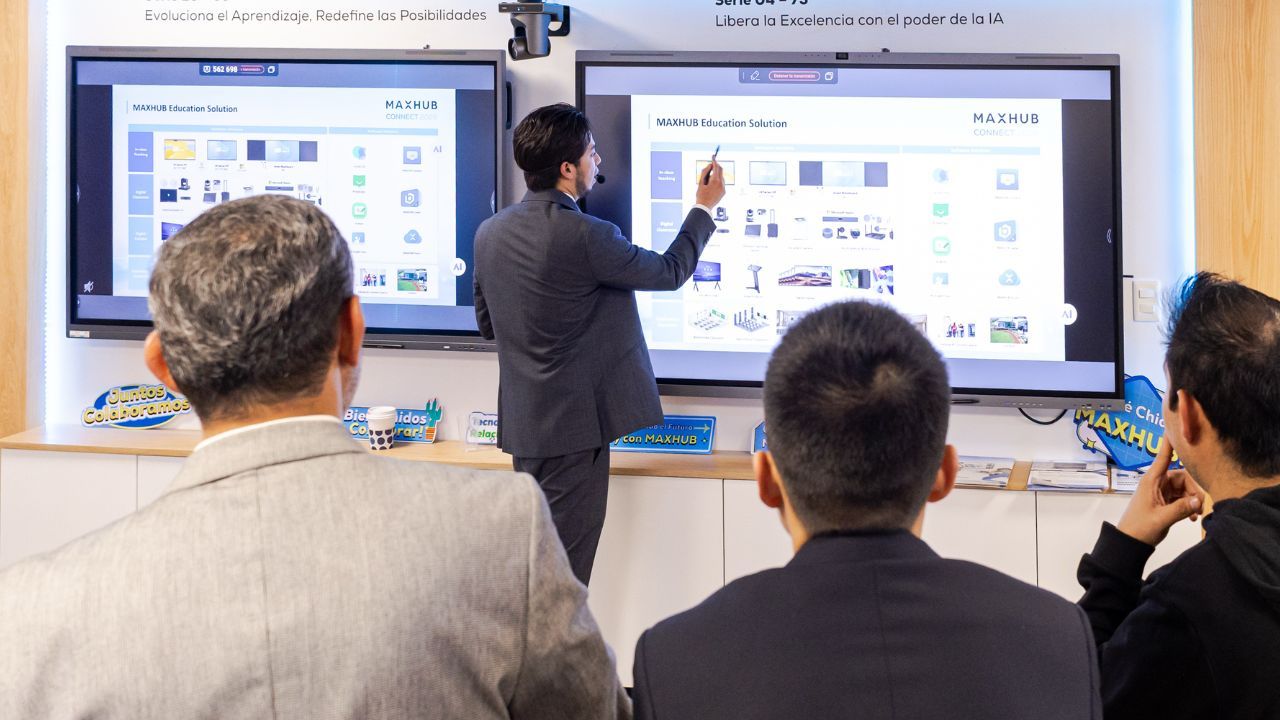
In terms of technology adoption, MAXHUB identifies two major trends in Latin America: the replacement of traditional projectors and monitors with interactive displays, and the growth of LED displays in corporate settings.
“We are seeing a rapid shift away from traditional projectors and ‘dumb’ monitors toward interactive displays.”
This change reflects new ways of collaborating, presenting information, and working with shared content. Interactive displays are no longer limited to the education sector; they are also gaining ground in meeting rooms, training rooms, innovation spaces, and corporate environments that require greater visual engagement.
At the same time, LED screens are no longer a solution reserved for large stages or massive events.
“There has also been a significant shift toward greater accessibility in the use of LED screens; while they were once reserved for large-scale events, companies in Latin America are now adopting them for their lobbies and boardrooms because of their low maintenance requirements and high durability.”
For system integrators, this opens up new possibilities for corporate communications projects, brand experiences, executive lounges, presentation centers, and spaces with high visual impact.
Toward Invisible Technology
The evolution of workspaces seems to be moving toward a common goal: for technology to function without being intrusive. Users shouldn't have to think about cables, configurations, platforms, or devices—they should focus on communicating, collaborating, and sharing ideas.
The MAXHUB team sums it up this way: “Workspaces are evolving toward invisible technology and equal collaboration.”
He adds: “The goal is for technology to be so natural, predictive, and easy to use that it fades into the background, allowing ideas and human connection to take center stage—regardless of whether you’re one meter or a thousand kilometers away.”
For Latin America, this trend represents a significant opportunity. As companies, educational institutions, and organizations update their spaces, the role of the integrator will become increasingly strategic: not just installing technology, but helping to design collaborative experiences that are simpler, more consistent, and ready to scale.
These trends will also be on display at InfoComm América Latina , where manufacturers, integrators, and end users will be able to learn about new solutions, compare approaches, and understand where the AV industry is headed in the region.
MAXHUB will showcase several new products at the event. “Our expectations for this year’s event are sky-high! Attendees will be able to see the latest advancements in our portfolio of Unified Communications solutions powered by next-generation Artificial Intelligence. We’ll be showcasing the latest in our line of interactive displays for corporate and educational settings, and of course, we’ll be demonstrating some innovative solutions. We’ll be placing a strong emphasis on our commercial LED display solutions, demonstrating why Maxhub is the leader in visual and collaborative innovation. We look forward to seeing you there!”
Sign up here and come visit them!