


Drones and the Transformation of Visual Experiences
)
In recent years, drones have evolved from being a tool used primarily in film production to becoming an increasingly common resource in the design of events and audiovisual experiences. Their ability to capture images from unique perspectives and perform dynamic camera movements opens up new possibilities for visual storytelling.
From concerts and festivals to brand launches and corporate events, drones can create memorable visual moments that amplify the impact of the experience.
Here are some key considerations for effectively integrating drones into event production.
1. Using drones to reveal the scale of an event
One of the most powerful uses of drones is their ability to showcase the full scale of a production. Aerial shots allow filmmakers to capture the sheer magnitude of sets, stage designs, audiences, and surroundings—something that is difficult to achieve with traditional cameras.
This type of content is particularly valuable for live streams, post-event promotional material, and social media coverage.
Aerial images help convey the energy of the event and immediately convey its scale.
“Few camera movements convey the scale of an event as immediately as a drone soaring over a festival or flying over a stage. What ground-level cameras fail to capture—the size of the production, the density of the crowd, or the relationship with the surroundings—becomes evident from the air,” explains Pablo Ledda, Director of International Sales at LANG AG.
“This makes footage captured by drones particularly valuable for both live broadcasts and post-production content, where a single aerial shot can convey what other images cannot.”
2. Incorporating drones into the visual narrative
Beyond aerial coverage, drones can become part of the event’s visual language. Their mobility allows for dynamic transitions between different areas of the stage or venue.
For example, they can follow artists or presenters, visually connect different spaces, or create cinematic movements at key moments.
When planned properly, the use of drones becomes a storytelling tool that adds dynamism to the audience’s experience.
“The most effective use of drones in visual storytelling is rarely just about aerial shots. It’s about continuity,” adds Pablo.
A drone that follows an artist from backstage to center stage, or that connects the audience with a set piece at a key moment, allows spaces to be linked in a way that stationary cameras cannot achieve.
“When the drone’s movements are planned in sync with the show’s rhythm, they become part of the event’s visual language.”
3. Combining drones with other visual technologies
Drones can have an even greater impact when integrated with other audiovisual technologies used at today's events.
Some combinations include:
- drones and large-format LED screens
- drones and synchronized lighting systems
- drones and mapping
- drones and fireworks
- drones and broadcast camera systems
When these elements are properly coordinated, it is possible to create more immersive and spectacular experiences.
“All these combinations share a common principle: the most immersive results aren’t achieved by using technologies in parallel, but by making them interact with one another,” Ledda points out.
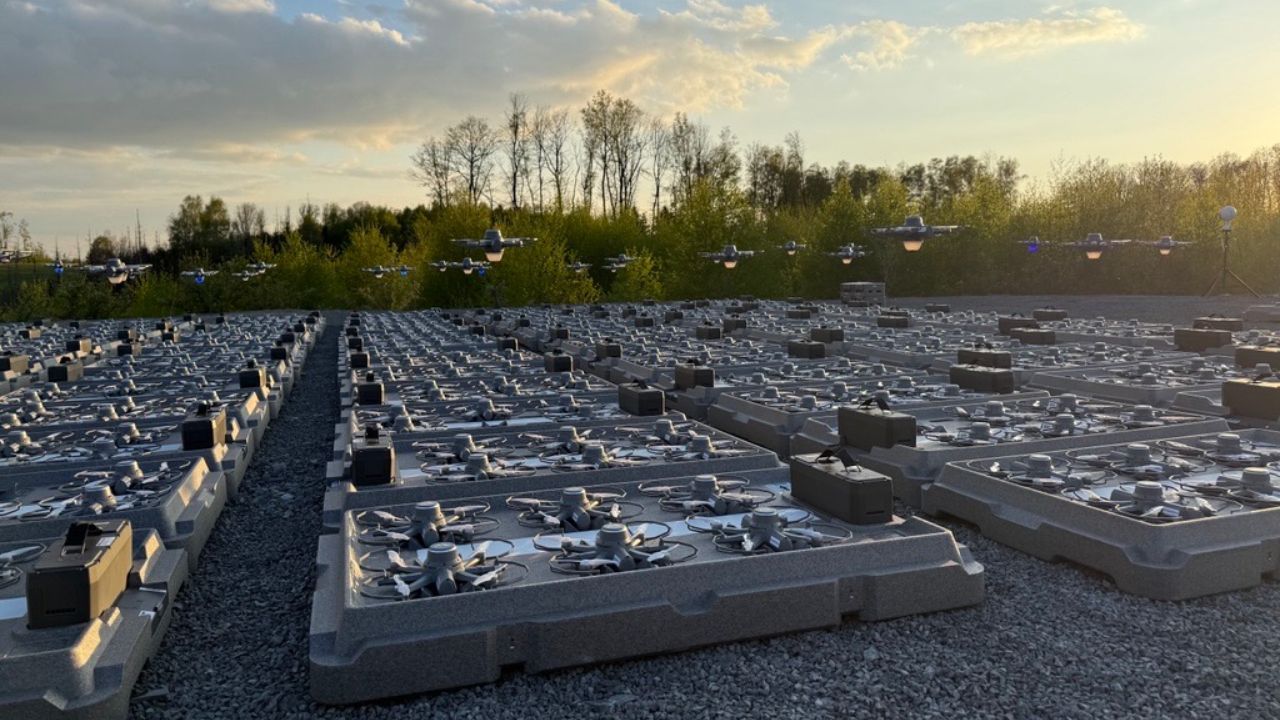
“A swarm of drones flying over a venue while a transparent LED installation displays complementary content does not create two separate experiences, but rather a single one.”
“What begins on the ground continues in the air. Technology takes a back seat, and the narrative takes center stage.”
4. Planning: Safety and Technical Operations
Although drones open up new creative possibilities, their use at events requires careful planning. Operating drones in public spaces involves taking technical and regulatory considerations into account.
Key points include:
- flight regulations in each country or city
- safe distance from the public
- coordination with lighting, rigging, and other stage elements
- advance planning of flight routes
In many cases, drones are operated by specialized pilots who work closely with the production team.
“One of the most underestimated aspects is just how much of the work happens before a drone even takes off. A feasibility analysis determines what kind of show is possible and what resources are needed,” explains Pablo.
“On-site setup and calibration require time and precision. Problems are much easier to resolve during testing than during the actual event. The sooner these factors are incorporated into the planning process, the greater the creative freedom.”
5. Think about the content beyond the event
Footage captured by drones adds value not only during the event, but also afterward.
Aerial shots are widely used in promotional videos, marketing campaigns, social media, and documentary films.
Planning the use of drones with these applications in mind can significantly increase the return on investment.
“The social media aspect should be taken into account from the very beginning. Aerial shots have a unique ability to grab attention and make people stop scrolling,” says Ledda.
“The same goes for drone shows: they produce images and moments that remain valuable long after the event.”
The Future of Drones in the Audiovisual Industry
As technology evolves, drones are gaining new capabilities such as higher-resolution cameras, improved stabilization, obstacle-avoidance sensors, and automated flight.
These innovations are expanding their role in both content creation and the production of audiovisual experiences.
When strategically integrated, drones offer new perspectives, visual dynamism, and innovative ways to connect with the audience.
“When it comes to cameras, improvements in resolution, stabilization, and maneuverability mean that shots that were once complex or impossible are now commonplace,” explains Pablo.
“In drone shows, the trend is toward greater scale, precision, and synchronization. But perhaps the most significant change is that the technology is becoming more accessible, bridging the gap between the idea and its execution.”
“This means greater ambition… and higher expectations from the public as well. The ‘wow’ factor won’t go away, but it will become increasingly difficult to achieve,” he concludes.
Given the importance of imagery and visual storytelling in the audiovisual industry, drones not only offer new perspectives but also new ways of telling stories.
LANG AG will be showcasing this technology—along with many others—for the first time at InfoComm América Latina. Register and visit their booth to learn how to incorporate them into your upcoming productions.