


AV Infrastructure That Stands the Test of Time: The BIVA Case Study
)
That is exactly what happened when the Institutional Stock Exchange (BIVA) designed its new headquarters in Torre Esmeralda, in Mexico City. From the outset, the goal was clear: to create an audiovisual environment capable of supporting live presentations, internal communication, high-profile events, and continuous operations—all in accordance with the reliability standards typical of the financial sector.
The solution had to meet three essential criteria: high stability, intuitive operation, and true long-term scalability.
A two-phase project (with plans for future updates)
The system was implemented in two phases. In 2018, the common areas, trading floor, lobby, and monitoring areas were upgraded, and in 2019, the main auditorium was upgraded, with a transition from HD to 4K in common areas scheduled for 2023.
This last point is key: the system wasn't replaced—it was upgraded. That speaks to an architecture designed to evolve.
BIVA partnered with the systems integrator Kolo, adopting MuxLab's AV-over-IP technology as the core of the distribution system.

Technical architecture: flexible layout and centralized control
The auditorium includes:
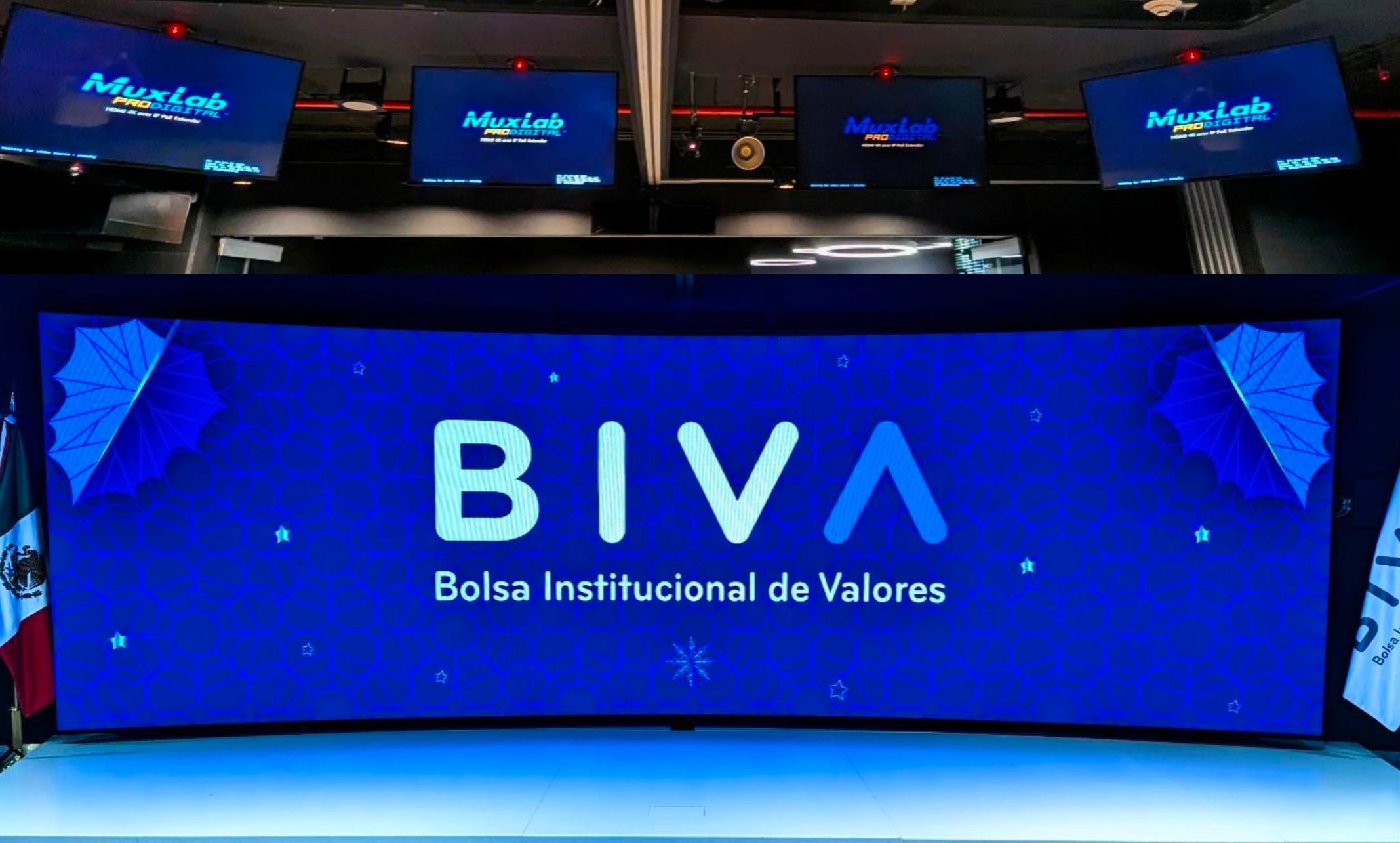
- Two 3×3 video walls
- A large-format LED display powered by a Digibird processor
- Four 43-inch monitors for a teleprompter
- Auxiliary displays
- Dedicated monitors in the control room
Each of these components is powered by MuxLab transmitters and receivers, ensuring flexible and uninterrupted content distribution. Screens were installed in common areas for financial information, corporate communications, live visitor signage, and security monitoring.
In total, the installation included thirty-two 500759-RX receivers, twenty-two 500759-TX transmitters, two 500773-TX transmitters, three 500811 units, and one 500812 unit. All of these devices are managed through the MuxLab network controller’s graphical user interface, which provides operators with an intuitive interface for making real-time adjustments.
Here’s an interesting technical point for integrators: centralized management made it possible to do away with third-party systems for control and advanced switching. This simplifies the architecture and reduces unnecessary layers.
From a traditional model to a network-based model
A few years ago, when BIVA opted for an AV-over-IP architecture, the market was still debating between traditional matrix systems and network-based distribution. Today, in 2026, the convergence of AV and IT infrastructure is already standard practice in high-level corporate settings.
In hindsight, the decision not only addressed an immediate need—it also foreshadowed the direction the market would take.
Long-term reliability
One of the strongest aspects of the case is not the initial setup, but rather its sustained performance.
Over the course of six years of operation, the system has proven to be stable and user-friendly, backed by regional technical support.
In the words of Héctor García Díaz, Multimedia Production Specialist at BIVA: “As the system’s primary operator, I can attest to the reliability and ease of use of MuxLab products over the past six years. The support team has always provided timely and effective assistance, which has been key to maintaining system performance and ensuring operational continuity.”
In the financial sector, where any disruption can damage a company’s reputation, this is no small matter.
What this case means for the AV industry
This project offers several useful insights for integrators and consultants working with institutional clients:
1. Design with upgrades in mind, not replacements: The transition from HD to 4K in 2023 demonstrates that an IP-based architecture can evolve without having to rebuild the entire system.
2. Separate technical operations from day-to-day operations: The operator does not need to be a network engineer. The interface must be clear and allow for real-time adjustments during high-profile events.
3. Design for redundancy and stability from the outset: In financial markets, reliability is not an added value—it is a minimum requirement.
4. High-impact events require rapid reconfiguration: The ability to change video wall layouts or distribute new sources without complex reprogramming is essential in environments involving live broadcasts, press conferences, or major announcements.
Infrastructure that supports the institution's reputation
More than just an audiovisual project, what BIVA built at Torre Esmeralda is an institutional communication platform poised for growth.
In organizations where public image, transparency, and accuracy are integral to their brand, AV technology plays a strategic role.
And in this case, the decision to migrate to an AV-over-IP architecture made it possible to build a flexible, stable, and future-proof infrastructure.
If you’re planning your next project and considering these upgrades, we invite you to visit Muxlab at InfoComm América Latina , where their booth will be filled with new products and their team will be ready to help you find the solutions you need.