

7 Tips for Smarter and More Secure AV Management
)
Modern audiovisual environments are not just about large screens and speakers. As organizations adopt distributed AV solutions—such as video walls, hybrid rooms, or command centers—the management, monitoring, and security of these systems become critical.
Recently, manufacturers such as Sennheiser have launched cloud-based platforms designed to facilitate centralized AV management. These developments reflect market trends that can become best practices for integrators, IT managers, and project managers.
Check out these 7 key recommendations for smarter and more reliable audiovisual management.
1. Centralize monitoring and control
Cloud-based platforms allow you to view the status of multiple AV devices (microphone systems, mixing, distribution, etc.) in one place. This makes it easier to:
- Remote diagnostics.
- Automatic alerts.
- Preventing failures before they affect the user.
“This approach reduces the need for manual intervention and improves system availability,” said Hernán Domínguez, Sennheiser’s Sales Manager for Latin America.
2. Commitment to security by design
In enterprise solutions, security is no longer limited to the data network; it also extends to AV systems. Centralized management on secure platforms enables:
- User authentication.
- Role-based access control.
- Remote updates with verification.
This ensures both the security of the devices and the privacy of the transmitted events.
3. Take advantage of IP connectivity
More and more AV devices are “networked devices.” This opens up an opportunity to:
- Integrate audio, video, and control into a single infrastructure.
- Reduce physical points of failure.
- Enable scalability without unnecessary rewiring.
“System integrators who adopt AV over IP gain flexibility when designing modular systems,” Hernán noted.
4. Use data to make operational decisions
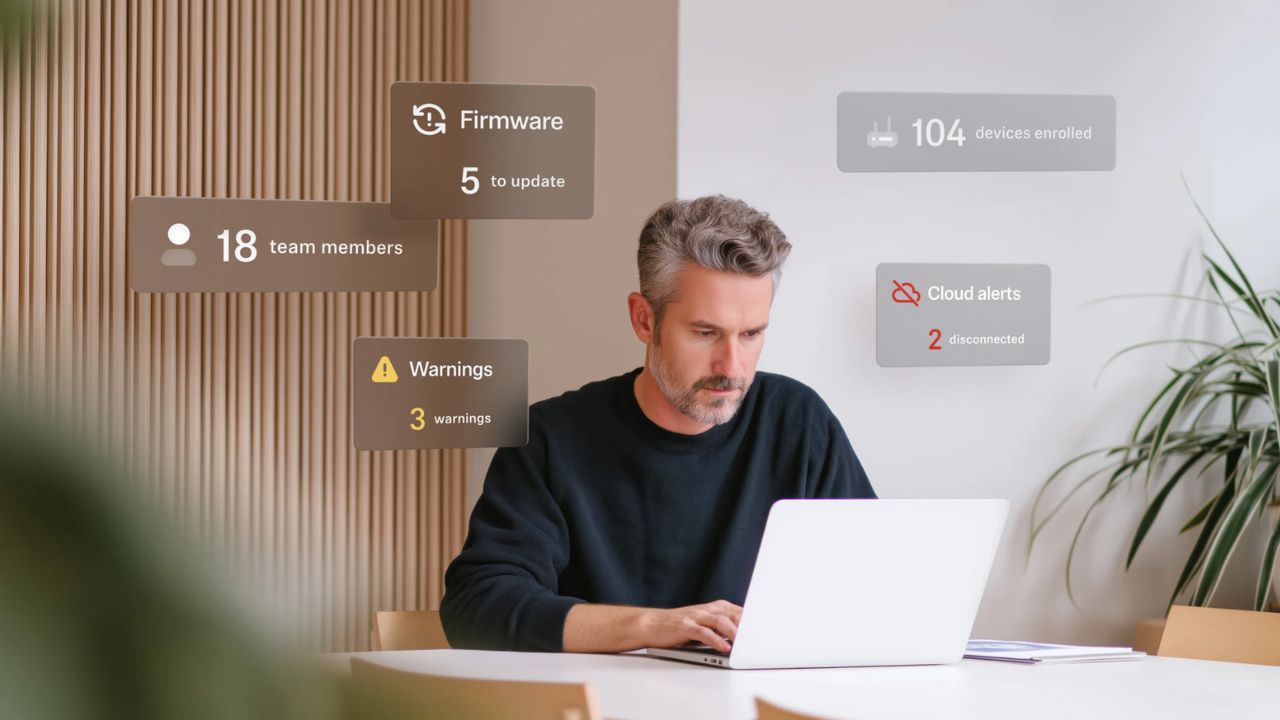
Modern management platforms provide dashboards and key metrics: usage by room, hardware alerts, signal quality, etc.
This allows you to:
- Identify usage trends.
- Plan preventive maintenance.
- Justify investments based on actual data.
Without data, decisions are based on perceptions; with data, they become strategic.
5. Facilitates updates and scalability
A good platform:
- It allows you to update device firmware simultaneously.
- Centralize bulk configuration changes.
- Manage devices without the need for physical intervention.
This is especially useful in large or distributed environments.
6. Simplifies the process for end users
Not everyone who uses an AV system is a technician. Intuitive interfaces allow users to:
- Adjust the volume or change fonts without needing specialized support.
- Define presets for different scenarios (presentation, conference, event).
- Train the internal team without a steep learning curve.
Smart management focuses on the user, not just the equipment.
7. Integrate platforms and consider the entire ecosystem
AV management should not be isolated. Ideally:
- It integrates with meeting platforms (Teams, Zoom, etc.).
- With digital signage platforms.
- With room management (sensors, schedules, reservations).
This transforms the audiovisual room into a truly connected and efficient space.
Why do these practices matter today?
The adoption of cloud-based AV management platforms is a response to the growing complexity of modern audiovisual systems. When an organization can monitor, control, maintain, and scale its infrastructure from a secure, centralized dashboard, downtime is reduced, administration is simplified, and collaboration between AV and IT teams is facilitated.
One specific example is Sennheiser’s launch of its DeviceHub platform, a secure cloud-based solution designed to simplify the remote monitoring, management, and updating of AV devices.
The proposal addresses exactly what the market is demanding: centralized control, greater visibility into the status of equipment, efficient updates, and a smoother experience for both integrators and in-house IT and AV teams.
Today, with hybrid meeting rooms, distributed offices, and teams working from different locations, managing AV devices can no longer rely on manual checks or constant on-site support. Platforms like DeviceHub address this reality with tools designed for remote operation and greater visibility.
Anyone interested in learning more about this platform and other solutions for professional environments can speak directly with the Sennheiser team at InfoComm América Latina , where the company will showcase its latest innovations in corporate communication and AV management. Sign up here to receive all our news!